Only 1% of Workers Have Advanced AI Skills: What That Means for Your School's AI Literacy Plan
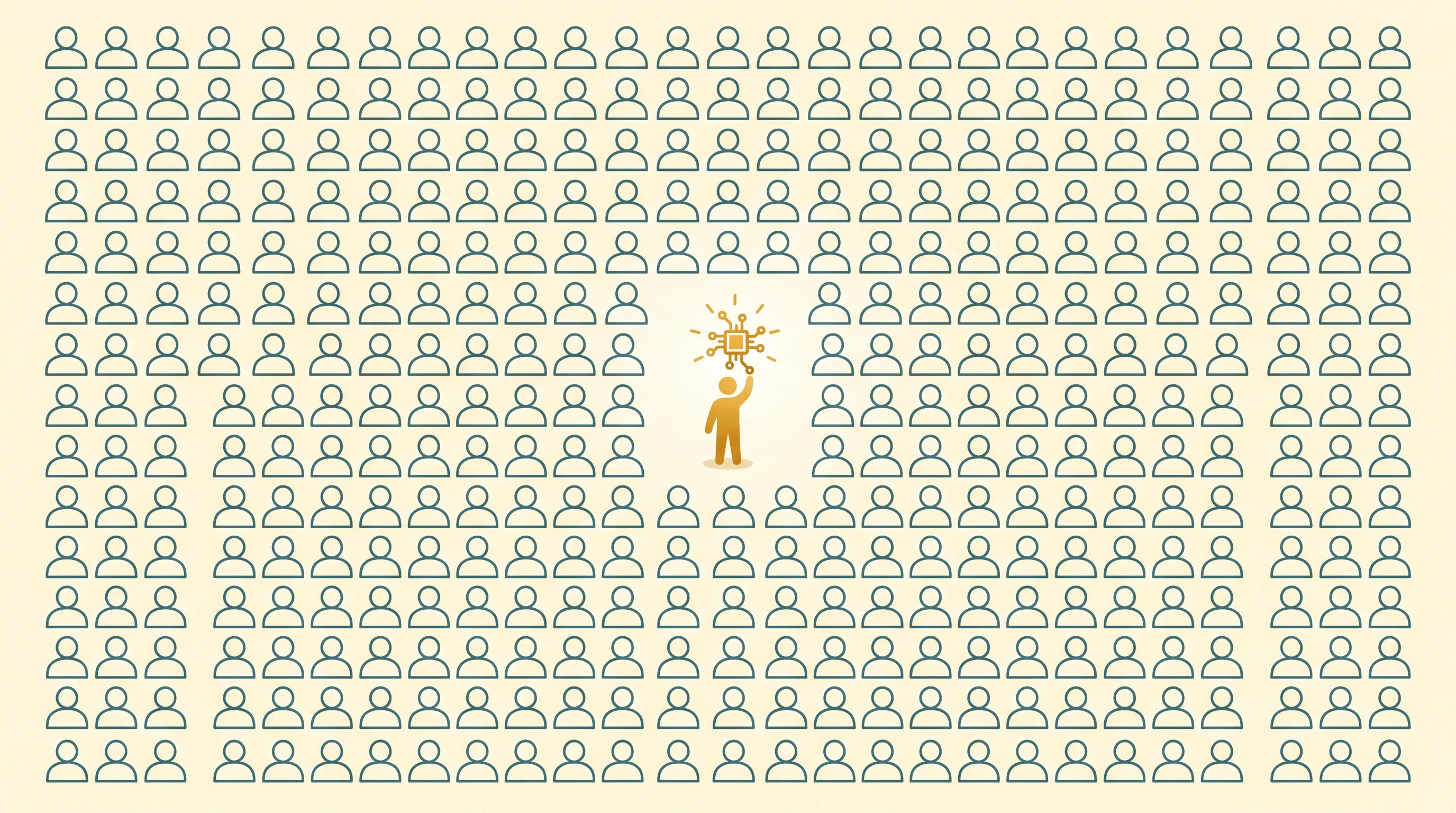
A parent reads the newsletter line about a new “AI literacy” unit and reacts one of two ways: relief that the school is preparing their child for a changing job market, or suspicion that it’s a trend the school jumped on without a clear reason. The OECD’s newest labour-market data gives schools a concrete, non-hyped answer to “why now” — and it isn’t the answer most people expect.
The OECD’s New Numbers: A Widening Gap
According to the OECD’s Skills in the AI age paper, published in 2026, workers with advanced AI skills still represent only about 1% of the workforce across OECD countries. That share has almost tripled from less than a decade ago — so demand is clearly rising — but it remains a small, specialized slice of the labour market Skills in the AI age (OECD AI Papers No. 60).
What makes that number striking is what’s happening on the employer side at the same time. AI adoption by firms roughly tripled between 2021 and 2025, rising from about 7% to 20% of firms across OECD countries, driven largely by generative AI tools Skills in the AI age. An independent summary of the same report confirms both figures and adds an important qualifier: adoption is uneven, with smaller firms facing more cost, infrastructure, and talent barriers than larger companies OECD report warns AI skills gaps could widen labour inequalities, Digital Watch Observatory.
A separate OECD paper prepared for the 2025 G7 Presidency puts numbers on that unevenness: across the OECD, 40% of large firms use AI compared with just 11.9% of small firms, and “skill shortages are consistently identified by SMEs as one of the main hurdles” to adoption AI adoption by small and medium-sized enterprises (OECD). (That same paper tracks a slightly different adoption window — 5.6% to 14% of firms between 2020 and 2024 — a reminder that these are separate OECD datasets measuring overlapping but not identical firm populations, not a contradiction.)
Put together: employers are adopting AI tools faster than the labour market is producing people who can use them well. That gap is the OECD’s central policy concern, and it’s the concrete, citable reason schools can give parents for introducing AI literacy now rather than waiting.
Why This Matters for Kids Still in School
The workforce gap has a mirror image in classrooms. A joint OECD/European Commission framework for AI literacy in primary and secondary education cites a 2024 study finding that 49% of 17- to 27-year-olds struggle to critically evaluate AI outputs — including recognizing when an AI system has simply invented facts Empowering Learners for the Age of AI (OECD/EC AILit Framework, Review Draft). A separate European survey of 12- to 17-year-olds cited in the same framework found that 74% believe AI will play a significant role in their future careers, but only 46% think their school adequately prepares them for it — and 49% worry AI could widen achievement gaps among their peers.
It’s worth being precise about what this evidence does and doesn’t show. The OECD’s papers are descriptive and policy-oriented — they document adoption trends and skills shortages and recommend that governments invest in AI literacy — but they are not intervention studies that measured whether a given curriculum actually closes the workforce gap, and the AILit Framework itself is still a review draft as of May 2025, with a final version expected in 2026. Schools should present AI-literacy programs as a reasonable, well-evidenced response to a documented gap — directional guidance, not a guaranteed fix backed by outcome data — while the underlying survey data on student readiness stands on its own.
AI-Literacy Curricula Is Not the Only Factor
None of this happens in a vacuum. A peer-reviewed review of AI-education adoption found that unequal access is associated with infrastructure gaps, cost of tools, and — critically — teacher digital-literacy deficiencies, which are associated with diminished instructional quality Digital Divide in AI-Powered Education (JISEM). Separately, OECD data shows U.S. teachers earn less than 60% of what similarly educated workers earn, and adult literacy scores have declined across all age groups since 2012 — a resource backdrop that correlates with, and plausibly constrains, how well any new AI curriculum can actually be delivered Education at a Glance 2025, US Country Note (OECD). A well-designed AI-literacy unit taught by an under-resourced, under-trained staff is likely to underperform one taught with adequate support — the curriculum is one input among several.
Who’s Already Building This Into Curricula
This isn’t a hypothetical policy idea — governments are already funding it, and the clearest examples come from outside the United States. Estonia launched its national “AI Leap” initiative in 2025, a public-private partnership with OpenAI, Anthropic, and local tech firms that reached more than 20,000 high school students and 3,000 teachers in its first phase, with free laptops provided to students from low-income households and funding rising from EUR 3.2 million to EUR 6 million Skills in the AI age (Box 3). Finland’s “Elements of AI” course, developed at the University of Helsinki and translated into multiple languages, remains one of the most widely referenced free AI-literacy resources in Europe. At the policy level, the EU AI Act’s Article 4 already sets an AI-literacy requirement that education systems are building toward AILit Framework. Korea’s “AID 30+” project takes a workforce-training angle, offering career vouchers worth up to KRW 350,000 a year to roughly 10,000 adults through 100 designated universities Skills in the AI age (Box 1).
As supporting evidence of the broader trend — not the primary case for it — U.S. states are moving in the same direction, though largely through policy mandates and pilots rather than the funded national programs described above. By the end of 2025, 34 states had adopted statewide AI guidance for K-12 schools. Massachusetts piloted a foundational AI curriculum for more than 1,600 students across 30 districts; Maryland ran an AI-tutoring pilot with 4,350 students; Ohio became the first state to require every K-12 district to adopt a formal AI policy, by July 1, 2026 States Take Next Steps on Governing AI Use in Schools (NASBE). None of these sources describe how the states or districts communicated the reasoning to parents — that gap is exactly what this article is addressing.
What Schools Should Actually Tell Parents
Given all this, the parent-facing message doesn’t need to be complicated. It needs three things: the gap (only 1% of workers have advanced AI skills, even as employer demand triples), the readiness problem (fewer than half of surveyed teens feel their school is preparing them, and about half struggle to evaluate AI output critically), and the school’s specific, concrete response — not a vague commitment to “embracing AI.”
In practice, this looks like a short email sent home the week before an AI-literacy unit starts: two or three paragraphs naming the specific tool or activity being used, how any student data is handled, and one example of the actual task students will complete — not a generic announcement that “AI is coming to the classroom.” For example: “Starting Monday, 6th graders will use [tool] for one guided lesson on spotting AI-generated misinformation. No account or personal data is required beyond a first name.”
It also looks like a once-a-semester, 30-minute parent information session, timed to the rollout of a new policy or tool (not buried in a general back-to-school night), where staff walk through what the school is teaching and why, and take questions live.
And it looks like a pinned FAQ in whatever channel the school already uses to reach parents — updated every time the AI policy changes, rather than published once and left to go stale — so a parent who missed the email can still find the answer without emailing the office. One question it should always answer: “Does the school use a specific AI tool with our child’s data, and can I opt out?”
The Question Is When, Not Whether
The operational requirement underneath all three of those examples is the same: a channel parents actually check, used consistently enough that a school update about AI in the classroom doesn’t get missed the way a one-off email does. That’s a communication-infrastructure problem before it’s an AI problem — and it’s one every school already has some system for, whether that’s a WhatsApp group, a paper newsletter, or a dedicated parent-communication platform.
A platform like BeeNet is one implementation path for that infrastructure — structured messaging channels that let a school separate a policy FAQ from day-to-day announcements, and confirm parents actually opened the AI-literacy notice rather than hoping they scrolled past it — not the only way to solve it. What matters is that the gap the OECD just quantified is real, growing, and already shaping curricula from Tallinn to Columbus. The question for any individual school isn’t whether to explain that to parents. It’s when.
References
- OECD. “Skills in the AI age” (OECD Artificial Intelligence Papers No. 60). 2026. https://www.oecd.org/content/dam/oecd/en/publications/reports/2026/07/skills-in-the-ai-age_e8d8c1e6/972bd15e-en.pdf
- Digital Watch Observatory (DiploFoundation). “OECD report warns AI skills gaps could widen labour inequalities.” 2026. https://dig.watch/updates/oecd-ai-skills-labour-market
- OECD / European Commission (AILit Framework). “Empowering Learners for the Age of AI — AI Literacy Framework for Primary & Secondary Education” (Review Draft). May 2025. https://ailiteracyframework.org/wp-content/uploads/2025/05/AILitFramework_ReviewDraft.pdf
- National Association of State Boards of Education (NASBE). “States Take Next Steps on Governing AI Use in Schools.” February 2026. https://www.nasbe.org/states-take-next-steps-on-governing-ai-use-in-schools/
- OECD. “Education at a Glance 2025 — United States Country Note.” 2025. https://www.oecd.org/content/dam/oecd/en/publications/reports/2025/09/education-at-a-glance-2025-country-notes_9749f4ff/united-states_e87f109d/784df67f-en.pdf
- Journal of Information Systems Engineering and Management. “Digital Divide in AI-Powered Education: Challenges and Solutions for Equitable Learning.” 2025. https://jisem-journal.com/index.php/journal/article/view/3327
- OECD. “AI adoption by small and medium-sized enterprises” (discussion paper for the 2025 G7 Presidency of Canada). 2025. https://www.oecd.org/content/dam/oecd/en/publications/reports/2025/12/ai-adoption-by-small-and-medium-sized-enterprises_9c48eae6/426399c1-en.pdf

Ready to Transform Your School Communication?
Start saving time and increasing parent engagement with BeeNet.
Request Demo