SMS Campaigns That Show the Bill Before You Send
Every school SMS tool can send a message. BeeNet shows you how many families are reachable, how many are SMS-eligible, and exactly what the send will cost — before you confirm it. Then it tells you who actually received it.
What Makes This Different
Four specific, checkable mechanisms — not adjectives.
The Estimate Comes Before the Send
Recipient count, SMS-eligible count, and credit charge are calculated and shown as a separate step you have to confirm — not a number that shows up on next month's invoice.
"Delivered" Only Means Delivered
SMS and WhatsApp report real delivery receipts. Push, email and in-app don't — and BeeNet says so, instead of counting a dispatched push as a message someone received.
Refunds Only When It's Our Fault
Credits come back automatically for a send to an opted-out number, a queue overflow, or a suspended account. They correctly don't come back because a parent's phone was off — that's not a failure to refund.
You Choose What Leads the Cascade
SMS-first for urgent messages that must reach non-app families fast. SMS-fallback so a text only goes out — and only gets billed — after push and email have already failed to reach someone.
What the Campaign Module Actually Does
Built around the two things schools get wrong with SMS: unpredictable cost, and not knowing whether the message arrived.
See the Cost Before You Confirm
Composing a campaign returns an estimate before anything is sent: how many recipients match your audience, how many of those are SMS-eligible, the charge in credits, and the tariff version used to calculate it. You confirm as a separate step — nothing leaves the building on a mis-click.
SMS-First or SMS-Fallback, Per Campaign
Choose the order per send. SMS-first cascades SMS → push → email for urgent messages that must reach families without the app. SMS-fallback cascades push → email → SMS, so you only pay for a text when the free channels have not reached someone.
Delivery Receipts, Not Just 'Sent'
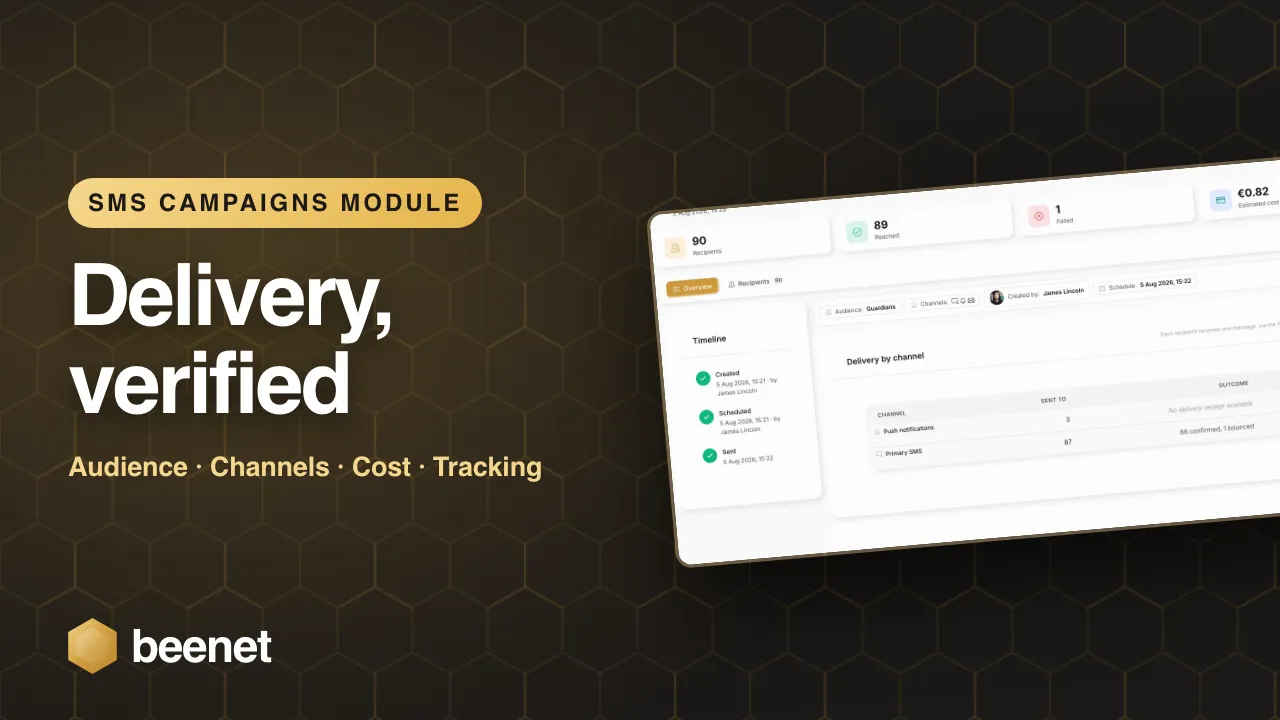
SMS and WhatsApp return real delivery receipts; push, email and in-app do not. BeeNet classifies each channel explicitly and reports reach accordingly, rather than counting a dispatched push as a delivered message. Your reach figure means what it says.
Seven Outcomes per Recipient
Each recipient resolves to pending, sent, delivered, undelivered, failed, fell-through, or suppressed — with the channel used and the failure reason recorded. 'Fell through' means the cascade tried every channel and none reached them: the list of families you need to phone.
Prepaid Credit Wallet, No Monthly Fee
The SMS module carries no subscription cost. You top up a credit wallet and spend it per message. Credits are refunded automatically when a failure is ours — a send to an opted-out number, a queue overflow, a suspended account — and correctly not refunded when a handset is simply unreachable.
Targeted Audiences, Include and Exclude
Build the recipient list from include and exclude segments rather than one flat list — a whole year group minus the class already notified, or every guardian in two clubs but not the staff who run them. The estimate recalculates against the resolved audience, not the raw headcount.
How This Compares to a Typical School SMS Tool
Generalised from published vendor pricing pages and terms — not naming a specific competitor, since a specific number is only as current as the day it was checked.
| Typical school SMS tool | BeeNet | |
|---|---|---|
| Cost before sending | Charge shown after sending, or not itemised at all | Recipient count, SMS-eligible count and credit cost shown before you confirm |
| "Delivered" status | Usually means dispatched, not confirmed received | Only SMS/WhatsApp are reported as delivered; push/email are reported as dispatched, not delivered |
| Failed sends | No refund policy stated, or a flat non-refundable credit | Refunded automatically on the platform's own faults; not refunded for a genuinely unreachable handset |
| Monthly cost | Flat subscription regardless of usage, or metered with no free tier | €0/month — billed only per message sent from a prepaid wallet |
| Channel order | One fixed channel, or no ordering control | SMS-first or SMS-fallback, chosen per campaign |
How a Campaign Runs
Compose and target
Write the message, pick the include and exclude segments, and choose whether SMS leads the cascade or backs it up. Schedule it, or leave it to send on confirmation.
Read the estimate
Before confirming, you see the resolved recipient count, how many are SMS-eligible, the credit charge, and the tariff version behind it. If the number is wrong, the audience is wrong — fix it here, not after the invoice.
Confirm and cascade
On confirmation the campaign moves through its status lifecycle — scheduled, sending, sent — and each recipient walks the channel order until one channel reaches them or the cascade is exhausted.
Read the real reach
Per-channel statistics separate attempted, sent, delivered, undelivered, failed and suppressed, with a reach rate that only counts channels able to prove delivery. Anyone who fell through is listed by name.
See It in Action
Watch the walkthrough below, or book a live demo to see this feature for your organisation.
Why It Matters for a School
Not a binary sent/failed. You can tell a suppressed opt-out apart from a handset that never answered, and act differently on each.
SMS, push and email in a single ordered send, so one campaign reaches app families and non-app families without you running two systems.
The charge is calculated and shown against a recorded tariff before you confirm, so the cost of a send is a decision rather than a surprise.
Common Questions
Can I see the cost before I send a campaign?
Yes — composing a campaign returns the recipient count, the SMS-eligible count, the credit charge, and the tariff version used, as a separate step before you confirm. Nothing sends until you approve that estimate.
Do I get charged for a message that fails to send?
Credits are refunded automatically when the failure is BeeNet's fault — a send to an opted-out number, a queue overflow, a suspended account. They are correctly not refunded when a handset was simply unreachable; that's a real attempt, not a platform failure.
How do I know if a message was actually delivered, not just sent?
SMS and WhatsApp return real delivery receipts, so BeeNet reports those as delivered or undelivered. Push, email and in-app messages don't provide delivery confirmation from the carrier or device — BeeNet reports those as dispatched rather than claiming a delivery it can't verify.
What happens to a family that never receives the message on any channel?
That recipient is marked "fell through" — the cascade tried every channel in the order you set and none of them reached them. You get a named list of exactly who that is, rather than a single failure count to investigate.
Is there a monthly subscription fee for SMS?
No. The SMS module itself costs €0 per month. You top up a prepaid credit wallet and are billed only for the messages you actually send.
Can I choose whether SMS is the first channel tried or a last resort?
Yes, per campaign. SMS-first tries SMS, then push, then email — for urgent messages that need to reach families without the app immediately. SMS-fallback tries push, then email, then SMS last, so you only pay for a text when the free channels didn't get through.
Related features
See a Campaign Estimate Before It Sends
Book a demo and we will compose a real campaign against a sample audience — audience resolution, cost estimate, cascade order, and the reach report it produces.
Request Demo