SMS Fallback: The School Families Your App Notifications Miss
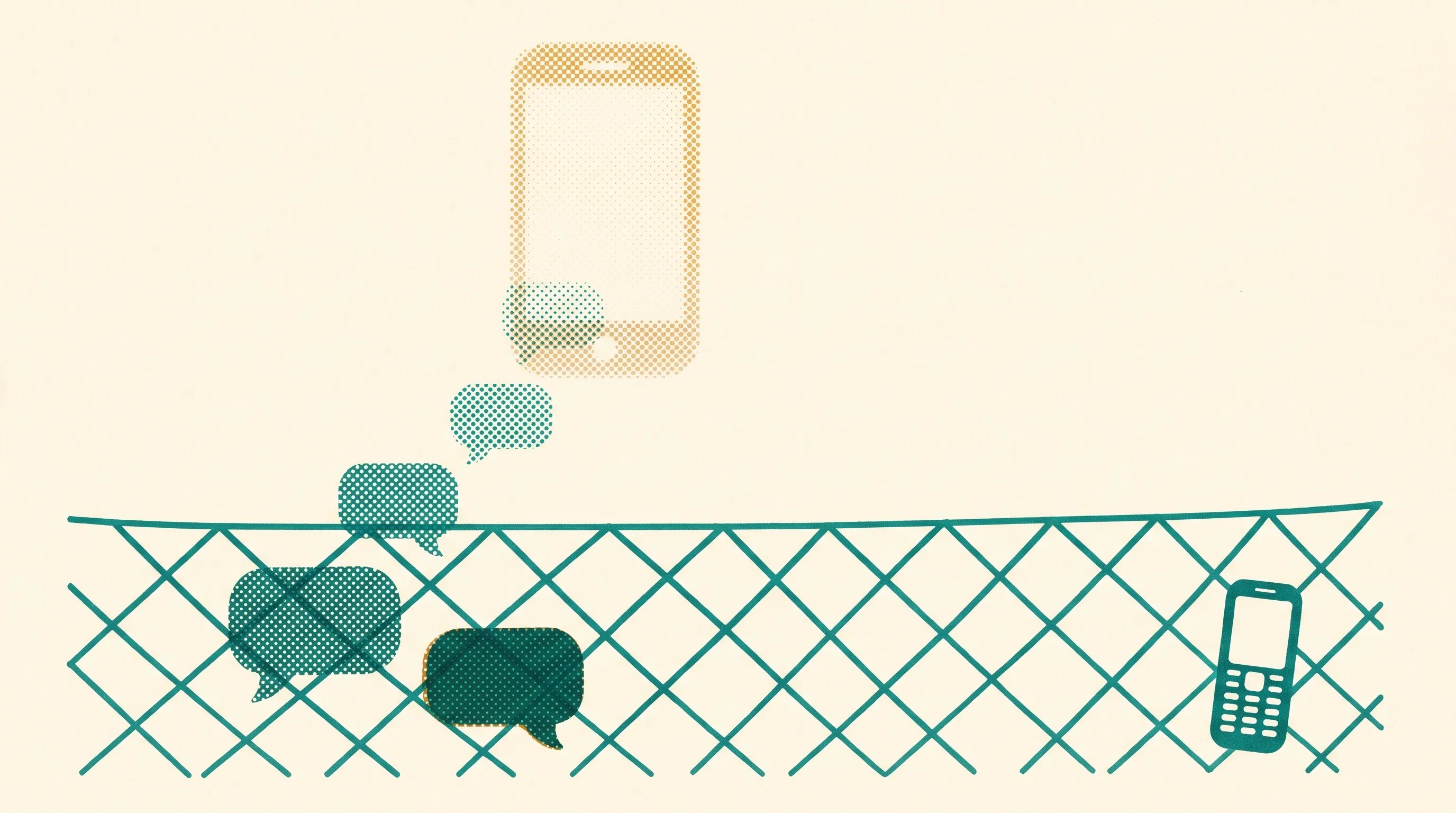
Amina is marked absent by 9:15 a.m. The push notification fires to her mother’s phone. Nothing happens — not because her mother doesn’t care, but because the phone it landed on has no data plan left this month.
An SMS fallback for school notifications exists to catch exactly that parent: someone whose phone, data plan, or digital skills make an app-based or push alert unreliable — not someone who is simply choosing to ignore the school. Pew Research Center’s January 2026 survey found a 40-percentage-point gap in home broadband subscription between U.S. households earning under $30,000 and those earning $100,000+, and that roughly a third of lower-income adults are smartphone-dependent — meaning a phone, not a home broadband connection, is their only way online. That’s a materially worse setup for loading a school app than a phone plus home broadband. If a notification strategy stops at push and in-app messages, that gap isn’t a rounding error. It’s a predictable, structural blind spot — one that makes a case for treating SMS as a fallback layer rather than an optional extra channel.
Quick answer: Layer SMS as an automatic fallback behind push and in-app alerts, not a parallel system. Three patterns cover most of what a school needs: attendance alerts escalate to SMS after 15 minutes without an app-open confirmation, emergency and closure alerts fire on SMS and push simultaneously, and payment or form deadlines text a link after 48 hours of no in-app open. Jump to the full setup guide for the trigger logic and a three-question self-audit.
Which Parents Your School App Notification Never Reaches
The gap isn’t random, and it isn’t about parental interest. It tracks income, formal education level, age, and — outside wealthier markets — basic phone ownership itself.
In the United States, Pew’s 2026 data shows 91% of adults own a smartphone, but ownership isn’t the whole story: about a third of adults in households earning under $30,000 a year are “smartphone-dependent,” compared with just 4% of those earning $100,000+. Smartphone-dependent users are also more exposed to the kind of friction — data caps, delayed app updates, apps uninstalled to free up storage — that quietly breaks push notifications without the parent ever making a conscious choice to opt out.
In the EU, the constraint is less about owning a device and more about knowing how to use one. Eurostat’s 2025 digital skills data reports that 60% of EU citizens aged 16–74 have at least basic digital skills — up from 54% in 2021, but still well short of the EU’s 80%-by-2030 target. That average hides a steep split: 82% of adults with high formal education have basic digital skills, versus 38% of those with no or low formal education. By age, only 33% of 65–74 year-olds clear that bar, versus roughly 75% of 16–34 year-olds. When a grandparent or older relative handles school-related communication for a family, they may well be on the wrong side of that line.
Outside high-income markets, a share of parents simply don’t have a smartphone to install an app on. GSMA’s 2025 Mobile Gender Gap Report found that across low- and middle-income countries — a category that includes several markets where BeeNet’s Gulf and Francophone-Africa customers operate — 61% of women own a smartphone compared with 71% of men, a 14-percentage-point gap that has not moved. GSMA puts the absolute number at roughly 230 million fewer women owning smartphones than men, with 400 million women owning no mobile phone at all. Basic and feature phones, which can receive SMS but can’t run an app, remain common in exactly the households a school most needs to reach.
Why Texts Get Through When Apps Don’t
An SMS fallback for school notifications works because it removes every precondition an app-based alert quietly assumes: that the recipient has a smartphone (not a feature phone), that the app is still installed, that push notifications are enabled, and that the device has enough data or Wi-Fi access to load the message. A text message needs none of that — it lands on any phone capable of receiving calls, using the cellular network’s built-in messaging protocol rather than a data connection. That’s a structural difference, not a marginal one: it’s the difference between “the message was sent” and “the message could physically arrive.”
A U.S. Case Study: What Happens When Home Broadband Disappears
The clearest real-world illustration of this dependency comes from the United States, where a federal subsidy program’s end functioned as an unplanned natural experiment in what happens to school-connected families when home broadband becomes unaffordable.
The Affordable Connectivity Program (ACP), a $30-a-month federal broadband subsidy, ended on June 1, 2024. According to K-12 Dive’s reporting at the time, 3.1 million families of students receiving free or reduced-price school meals had relied on the program. A year later, the picture hadn’t self-corrected: reporting from BroadbandBreakfast, indexed by the Benton Institute for Broadband & Society, found that of the more than 23 million households that had relied on the subsidy, an estimated 5 million had disconnected from the internet altogether by mid-2025, and a January 2025 National Lifeline Association survey of former participants found nearly 40% had cut back on food spending to absorb the lost subsidy.
The ACP case is the strongest evidence in this space precisely because it’s closer to a controlled before/after than the survey data above: a real subsidy existed, then didn’t, and disconnections followed at scale. What it doesn’t directly measure is the specific downstream effect on school notification receipt — the link from “lost home broadband” to “worse app/push reliability” is a reasonable inference, not something the ACP studies measured directly.
SMS Fixes Reach — Not the Whole Engagement Gap
It would be convenient to conclude that adding SMS closes the parent-communication gap outright. The evidence doesn’t support that, and treating SMS as a total fix risks masking problems it can’t touch.
Three findings complicate a pure access story. Notley and Aziz’s 2024 ethnographic study of low-income migrant families in Western Sydney found that even households with devices experience digital inclusion as an ongoing social, financial, and emotional burden — having a channel that reaches your phone doesn’t erase the burden of using it without culturally tailored support. Separately, Asher, Scherer, Kim, and Tvedt’s 2024 analysis in Educational Researcher of family engagement with educational technology during 2019–2020 found distinct engagement patterns depending on whether families used two-way, interaction-supported texting or relied on one-way tools alone — with Spanish-speaking families notably more likely than English-speaking families to engage across the board, and particularly as interaction-supported users — suggesting the design of the channel (can a parent reply and get a response?) matters alongside which channel is used at all. And school-side behavior is part of the equation too: OECD PISA 2022 data, summarized by the European Commission’s School Education Gateway, reported a broad decline in parent-initiated and teacher-initiated discussions between 2018 and 2022 across most measured education systems — a drop in outreach volume that has nothing to do with what device a parent owns. Reach and outreach are two different problems, and SMS only solves one of them.
What an SMS Fallback Looks Like in Practice
Treating this as an architecture decision, not a feature toggle, is what separates schools that see it register with families from ones that add it and forget it.
-
Attendance alerts. Trigger: a student is marked absent by 9:15 a.m. Channel logic: push notification first; if no delivery confirmation or app open is registered within 15 minutes, fall back automatically to a one-line SMS — “Amina was marked absent from 1st period today. Reply if this is unexpected.” The trigger is time-based and delivery-based, not a manual staff decision, which is what makes it reliable at scale.
-
Emergency and closure alerts. Trigger: a weather closure or safety emergency. Channel logic: SMS and push fire to the full parent list simultaneously, not sequentially — for time-critical messages, the fallback logic skips the “wait and see” delay entirely and treats SMS as a primary channel alongside push, not a backup that only fires after push has already failed. Our free emergency-communication readiness audit scores exactly this kind of notification redundancy, plus the rest of your crisis-communication setup, in about five minutes.
-
Payment and form deadlines. Trigger: a fee or form due date is three days out. Channel logic: SMS goes to any guardian who hasn’t opened the corresponding in-app notification within 48 hours of it being posted, with the text including a short link back to the payment or form page rather than assuming the parent will remember to open the app separately.
A short way to check whether a notification system already has this kind of gap:
- Does every critical alert have a non-app delivery path?
- Does that path fire automatically, rather than requiring a staff member to notice and manually text a family?
- Can a parent reply to the text and reach a real inbox, not a dead-end shortcode?
If any answer is no, the reach gap documented above is live in that building today, not a hypothetical.
From App-Only to App-Plus-SMS: Making the Fallback Real
Strip away the vendor names and the operational problem is simple: a school’s most important messages — absences, closures, payment deadlines, safety alerts — are being delivered through a channel that a predictable share of families structurally can’t reliably receive, and that share tracks income, age, education level, and device type rather than how much a given parent cares. Fixing that requires two things working together: a channel that doesn’t depend on an app install or a data plan, and delivery logic that decides automatically, per message and per family, whether to use it — rather than leaving that judgment call to an already-stretched front office.
If a system doesn’t clear those three checks yet, one implementation path is a native SMS fallback layered into the same platform that sends push and in-app alerts — so an emergency or closure alert cascades to SMS automatically for the parents who need it, without the school having to run a parallel text-alert system or manage a second vendor relationship on top of its existing communication tool. BeeNet’s notification system works this way today for Emergency-category alerts, alongside push, in-app messaging, and WhatsApp Business delivery — attendance and absence alerts remain push-only, with SMS available separately as an admin-initiated broadcast campaign. See how the cascade rules work on BeeNet’s notifications page.
Not every school wants that layered into an existing platform, though — some are shopping for a standalone SMS product instead, sized to just the automated-emergency side or just the deliberate-broadcast side rather than both. Our comparison of eight standalone SMS alert vendors, sorted by which of those two jobs each one actually does walks through pricing and consent rules for exactly that purchase.
The data reviewed here doesn’t point to a single dramatic fix — it points to a predictable, quantifiable slice of families a push-only or app-only system will keep missing every term, for reasons that have nothing to do with how good the school’s messages are. Whether a school closes that gap with a native fallback, a separate SMS tool, or a manual workaround run by office staff, the reach gap documented above doesn’t close itself by staying on the current channel mix. The question for most schools at this point isn’t whether to add a non-app delivery path — it’s when.
References
- McClain, C. & Bishop, W. (2026, January 8). Internet use, smartphone ownership, digital divides in U.S. Pew Research Center.
- Eurostat (2025). Skills for the digital age. European Commission.
- GSMA (2025). The Mobile Gender Gap Report 2025.
- Notley, T. & Aziz, A. (2024). The unjust burden of digital inclusion for low-income migrant parents. Policy & Internet, 16, 428–442. https://onlinelibrary.wiley.com/doi/full/10.1002/poi3.383
- Merod, A. (2024, March 5). As the Affordable Connectivity Program sunsets, what’s next for schools? K-12 Dive.
- Casper, J. (2025, June 2). One Year Without the Affordable Connectivity Program. BroadbandBreakfast / Benton Institute for Broadband & Society.
- Asher, C.A., Scherer, E., Kim, J.S. & Tvedt, J.N. (2024). Understanding heterogeneous patterns of family engagement with educational technology to inform school-family communication in linguistically diverse communities. Educational Researcher, 53(6), 348–358. https://journals.sagepub.com/doi/10.3102/0013189X241238651
- European Commission, School Education Gateway (2025–2026). PISA 2022: Perspectives on parental involvement, summarizing OECD PISA 2022 Results Volume II.


Related BeeNet Features
Ready to Transform Your School Communication?
Start saving time and increasing parent engagement with BeeNet.
Request Demo