Morocco's Education Data Gap: What School Leaders Need to Know Beyond the UNESCO Headlines
UNESCO’s 2026 Global Education Monitoring Report delivers a headline worth celebrating: Morocco reduced its adolescent out-of-school rate from 42% to 6% between 2000 and 2023 — an 85% reduction that took a generation of sustained policy effort. For the MENA region, and for education systems globally, this is a genuine landmark. If you lead a school in Morocco — or anywhere building toward quality at scale — the second number in that report is the one that should be on your desk. Enrollment is not learning.
The Number Behind the Number
The 2026 GEM Report country case study and reporting by Hespress English confirm that at middle school level, only 19% of enrolled students achieve basic reading proficiency. Just 18% meet minimum math standards. Only one in four students who start school earns a high school diploma.
The system has solved the attendance problem. It has not yet solved the learning problem.
This is not a peripheral critique. It is the central challenge named by UNESCO itself. Morocco dedicated 5.9% of GDP to education in 2019 — roughly one-quarter of all government expenditures — yet ranks among the lowest international performers on standardized assessments, according to the IMF’s analysis of public education spending efficiency. Getting children into classrooms at scale was the first chapter. Making those classrooms effective at scale is the second.
What Pioneer Schools Found When They Designed for Learning
Morocco’s answer to this quality crisis is the Écoles Pionnières — Pioneer Schools — program. By the 2025–26 school year, it covered 4,626 public primary schools: 54% of Morocco’s entire public primary system. A Pioneer Middle-Schools pilot adds 786 schools serving 678,000 students, according to the World Bank’s feature analysis.
The program’s design is worth examining in detail, because it makes a choice that most school improvement programs treat as optional.
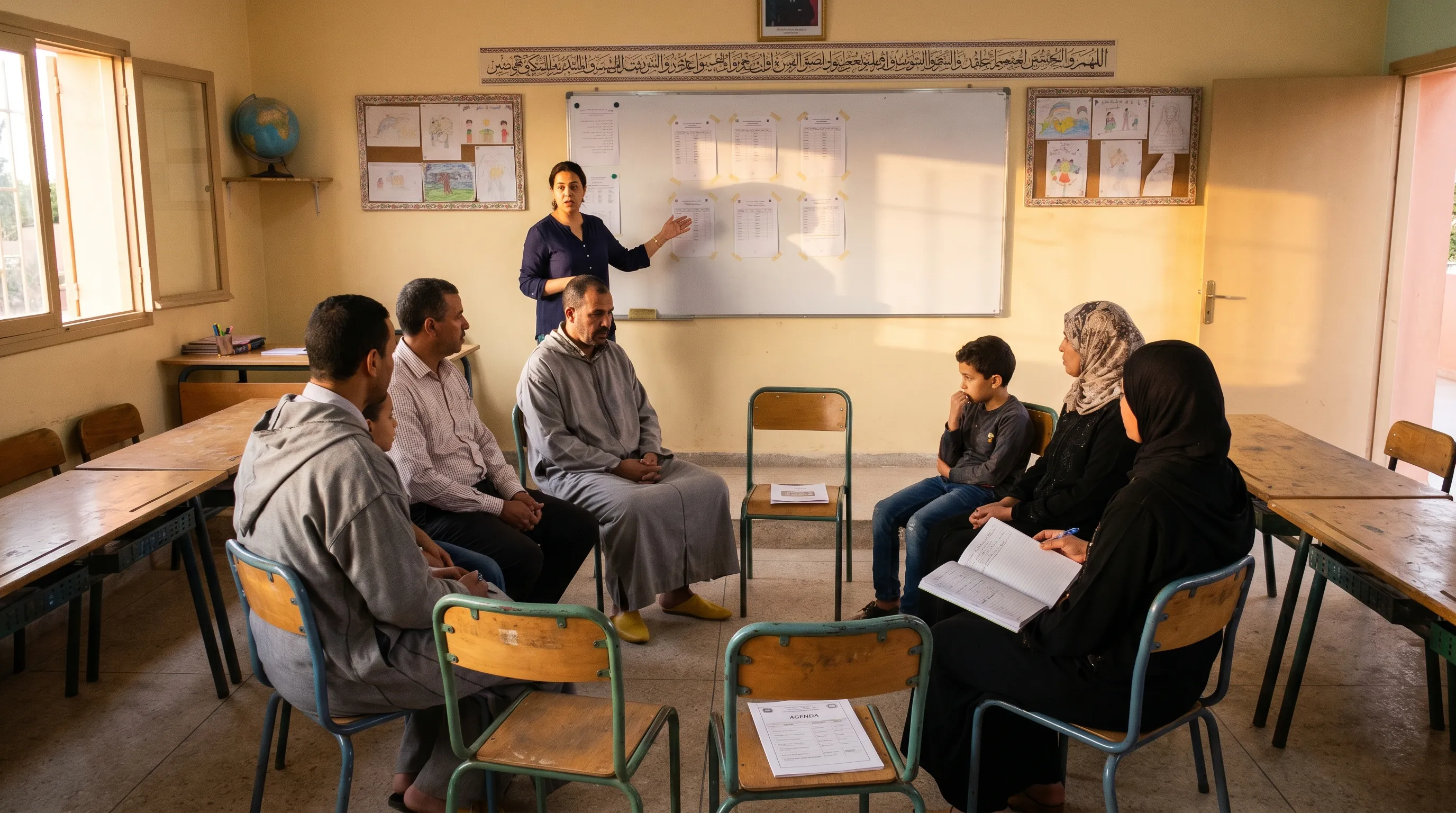
Pioneer Schools operate on a structured six-week assessment cycle. At the end of each cycle — after a post-test — there is a mandatory open house for parents, where assessment results are shared. The UNESCO GEM Report describes this as a structural design requirement, not a recommended practice: “the sixth week dedicated to a post-test, followed by an open house for parents, where the results are shared.”
Family communication is not an add-on. It is built into the rhythm of instruction.
The Results That Followed
The outcomes from Pioneer Schools have now been independently evaluated. Community Jameel’s Morocco Innovation and Evaluation Lab (MEL) conducted an independent impact assessment comparing Pioneer and non-Pioneer schools with a comparison group. The findings are specific:
- 31.4% reduction in end-of-year dropout rates — from 5.1% in comparison schools to 3.5% in Pioneer schools
- 0.52 standard deviation improvement in learning outcomes — the equivalent of tripling the pace of learning versus non-programme schools
- Community Jameel describes this as placing Morocco among the highest-performing intervention cohorts globally
A JPAL preliminary evaluation cited by the World Bank found that Pioneer Schools students outperform 82% of their peers in comparable schools after one year.
These are not incremental gains. They represent a meaningful departure from the trajectory that produced 19% reading proficiency.
Family Communication Is Not the Only Factor
It would be analytically dishonest to attribute Pioneer Schools’ outcomes solely — or even primarily — to the parental open house requirement. The program is a bundle of interventions: structured pedagogy, teacher coaching, assessment cycles, and family engagement working together.
More broadly, the deeper learning crisis in Morocco is overdetermined. Research by Abdesslam Boutayeb, published in the International Journal of Environmental Research, correlates student socioeconomic background with approximately 80% of learning outcome variance versus 20% attributable to school factors (drawn from 2014–2018 data — a structural baseline, not current measurement). The OECD TALIS 2024 report finds that despite approximately 90% professional development participation among Moroccan secondary teachers, only 42% use small-group instructional methods and fewer than 30% have adopted AI-assisted tools — a pedagogy gap that appears alongside the quality crisis. Rural-urban disparities and spending inefficiency compound these factors further.
The learning crisis is a systems problem. The Pioneer Schools data offers one confirmed lever; it does not offer the complete solution.
The 46% Without the Structural Scaffold
The 46% of public primary schools not yet in Pioneer Schools face the same communication design challenge without the same structural support.
As of 2025–26, Pioneer Schools covers 54% of Morocco’s public primary system. That means 46% of public primary schools — and the majority of middle schools not yet in the pilot — operate without the structural family communication requirement that Pioneer Schools embed by design.
Schools that want to replicate the Pioneer Schools communication rhythm would need a repeatable mechanism to deliver it at scale: knowing, at any given moment, which parents to contact, what results to share, and how to reach families who aren’t already in a WhatsApp group. Without infrastructure that makes this frictionless, communication tends to default to the events that do happen — annual report days, informal corridor conversations — rather than the regular cycle the Pioneer Schools model embeds.
What This Means in Practice for School Leaders
The Pioneer Schools model points to three operational requirements that school leaders can act on regardless of whether their school is formally in the program.
Build assessment-linked communication into your school calendar. Do not treat parent contact as something that happens when there is a problem. The Pioneer Schools model ties family communication explicitly to assessment cycles — every six weeks, without exception. In practice, this looks like: after each mid-term assessment, a short message goes to every parent within 48 hours — not a full report card, but a two-sentence update on one thing their child is managing well and one area where home support would help. Channel: in-app message or SMS. Length: under 60 words. Trigger: assessment results processed. Sample: “Youssef’s reading fluency improved this cycle — he’s finishing texts he started. Multiplication by 6 and 7 is his current stretch target; ten minutes of practice before bed two nights a week will make a difference at the next assessment.”
Remove friction from the open house itself. The Pioneer Schools requirement is an in-person open house, but the mechanism that makes it effective is that parents arrive informed, not surprised. In practice, this looks like: three days before each parent-teacher meeting, each parent receives a brief digital pre-brief identifying the two or three things their child’s teacher wants to discuss. Channel: in-app notification with a short text card. Length: three bullets. Trigger: 72 hours before the scheduled meeting. This converts a vague appointment into a conversation both sides are prepared for.
Make language and channel match the family, not the institution. Morocco’s RAE2C-Maroc network of 238 non-formal education centers works with families across significant literacy and language variation. A communication infrastructure that delivers formal Arabic PDFs to parents who read primarily in Darija, or sends messages during working hours to parents with shift-based schedules, will reach fewer families than one that adapts. The same message lands differently depending on register: a formal Arabic notification reads “نود إعلامكم أن أداء يوسف في اختبار القراءة قد تحسّن” while a Darija-register message covering the same ground reads “يوسف مشى زين فالقراءة هاد المرة — شكرا على المجهود” — the content is identical, but the second arrives as a message from a person rather than a form from an institution. In practice, this looks like: messages sent in the language and register the family enrolled with, at 7–9 pm rather than during the school day, with a two-tap acknowledgment option (confirming receipt or confirming open-house attendance) rather than requiring a full reply.
What Comes Next for Morocco — and for Your School
Morocco’s education story has two chapters. The first — 85% reduction in out-of-school youth over 23 years — is the story UNESCO is rightly celebrating. The second — 19% middle-school reading proficiency, 72% of students leaving without qualifications according to IMF analysis — is the story that will define the next 23 years.
The Pioneer Schools evaluation gives school leaders something rare: evidence from an independent impact assessment showing that a structural choice — embedding regular, assessment-linked family communication into the school cycle — is associated with a 31.4% dropout reduction and more than half a standard deviation of learning gain. That evidence does not belong only to the 54% of schools currently in the program.
The question for every school leader reading this is not whether regular family communication matters — the data answers that. The question is whether your school’s current infrastructure makes it possible to deliver that communication reliably, at scale, every six weeks, for every family. If the answer is no, BeeNet’s school communication tools are designed for exactly this — or see a demo to evaluate whether it fits your context.
Platforms like BeeNet handle exactly this operational layer — making the Pioneer Schools communication rhythm available to any school willing to implement it, not just those formally enrolled in the program. The platform is designed for MENA and European school contexts, with multilingual delivery and assessment-cycle communication built in as core features rather than optional modules.
The time to build that infrastructure is before the next assessment cycle — not after.
References
- Morocco | Global Education Monitoring Report — 2026 GEM Report Country Case Study — UNESCO / GEM Report, 2026
- UNESCO: Morocco cuts dropout rates, but learning gaps persist — Hespress English, 2026
- Morocco’s Pioneer Schools: Advancing Improved Student Learning — World Bank, 2026
- 200,000 Morocco students benefit from Pioneer Schools — Community Jameel / MEL, University Mohammed VI Polytechnic, 2025
- Morocco’s Education System Faces Deep Structural Challenges, TALIS 2024 Report Finds — Morocco World News (reporting on OECD TALIS 2024), 2026
- Education in Morocco: High Territorial Disparities and Severe Inequalities — Abdesslam Boutayeb, International Journal of Environmental Research (Iris Publishers), 2024
- Chapter 11: Efficiency of Public Spending on Education — International Monetary Fund, 2024
- Rethinking Global Education Rankings: A Critical Perspective — Morocco World News, 2025


Ready to Transform Your School Communication?
Start saving time and increasing parent engagement with BeeNet.
Request Demo