KHDA Parent Login: Portal Access and Complaints 2026

KHDA resolves a parent complaint against your school in as little as 10 working days — filed through the e-Feedback portal on KHDA’s own website, with no requirement that the parent go through your front office first. That’s the timeline KHDA states for “resolving regular complaint cases” once a complaint against a school, institution, university, or early childhood center is submitted through that form (KHDA e-Feedback). For a Dubai private school in 2026, that single fact changes how you have to run complaint handling: parents no longer need your permission to escalate, and KHDA’s own quality-assurance visits are coming back for 2026-27 with as little as 24 hours’ notice. If your internal complaint log isn’t already in a state you’d hand to an inspector, this is the year to fix that.
The KHDA parent portal: what it actually does
KHDA runs its e-Feedback system as three separate tracks, and schools often conflate them. There’s a complaint against a school (the one that affects you directly, resolved in up to 10 working days), a general enquiry (responded to within five working days), and a suggestion channel (KHDA e-Feedback). None of these routes are formally gated on the parent having exhausted your own complaints process first — KHDA’s guidance on handling bullying concerns, for instance, advises parents to “raise any incidents or concerns immediately with the school and, if you are not able to resolve the issue, please contact us” (KHDA Common Questions for Parents), which signals the general posture KHDA expects parents to follow rather than a strict precondition attached to every complaint type.
One structural point that trips schools up: schools need KHDA’s authorization before suspending or expelling a student, not after the fact. “Schools are not permitted to suspend or expel students without authorization from KHDA,” per the same parent FAQ page — a rule schools should have in writing in their own disciplinary policy, not just assume everyone knows. That FAQ page’s footer is dated December 2021 even though the site chrome shows 2026, so treat granular mechanics (like fee-related procedures) as a starting point to verify against your school’s PRO or KHDA account manager rather than a final word.
KHDA complaints: what timelines actually apply to you
“KHDA complaints” covers two entirely different things, and mixing them up is the most common internal-communication mistake we see. There’s the e-Feedback complaint against your school (10 working days to resolve, per the section above), and there’s KHDA’s own internal Customer Service Charter, which sets separate timelines for how KHDA handles complaints made against KHDA itself, plus a distinct “Disputes” track — the Charter defines a dispute broadly as a disagreement with an external party, which in a school context typically means schools and parents.
KHDA’s Customer Service Charter (Version 3.0) lays out the internal service standard: enquiries get a response within five working days; complaints against KHDA are acknowledged within one working day and investigated, with a proposed resolution and a request for feedback, within seven working days; disputes between education providers and students or parents are also acknowledged within one working day, though the Charter doesn’t attach a published day-count to how long the investigation and proposed-resolution step takes (KHDA Customer Service Charter). The charter is explicit on the complaints track: “We aim to acknowledge your Complaint within one working day,” and to “investigate your complaint, provide you with the proposed action to solve it, and seek your feedback about the proposed action within seven working days of receiving your complaint.” KHDA’s working hours matter here too — Sunday to Wednesday, 7:30am to 4:30pm, Thursday 7:30am to 2:30pm, except official holidays — so a complaint filed Thursday afternoon would, in practice, not begin counting toward those day limits until the following Sunday.
The practical takeaway for a school: whatever timeline you promise parents internally should sit comfortably inside the 10-working-day window KHDA itself uses for e-Feedback complaints against a school. If your own process routinely runs longer than that, a parent who escalates will get a faster answer from KHDA than from you — which is not the position you want to be in when an inspector asks how complaints are handled.
The UAE school calendar 2026-2027 you’re expected to already be tracking
Complaint handling doesn’t happen in a vacuum — calendar and attendance confusion is a recurring source of parent complaints, so the compliance calendar is worth stating plainly here. Dubai’s minimum required school days for 2026-2027 differ by term start: schools starting in September must deliver 185 school days, while April-start schools need 182 (KHDA Academic Calendar for Dubai’s Private Schools). Nationally, the UAE Ministry of Education has set the 2026-2027 school year to run from August 31, 2026, to July 2, 2027, with a mid-term break October 12-18, 2026, a winter break December 14, 2026 to January 3, 2027, and a spring break April 5-11, 2027 — and “all schools must follow the approved calendar, including holding final assessments or completing curriculum requirements in the last week of each term” (MoE academic calendar announcement). KHDA and ADEK retain some flexibility for schools on non-MoE curricula, but the minimum-days rule and the federal term dates are the two numbers worth getting right in every parent-facing channel — a break date changed mid-year without pushing it through every channel parents actually check is exactly the kind of gap that turns into a “why weren’t we told” complaint.
ADEK attendance policy 2026 and parent contracts: not the same rules as Dubai
It’s worth being precise here, because the two Emirates’ regulators are not running the same playbook, and conflating them in a parent-facing FAQ is an easy way to generate a complaint out of nothing. Abu Dhabi’s ADEK — not KHDA — enforces a 2025-26 attendance policy with hard numeric thresholds: kindergarten students are flagged past roughly 18 days (10%) of absence, and Grades 1-12 students past roughly 9 days (5%); sick notes are self-certified up to three consecutive days and 12 days a year, beyond which a Department of Health medical certificate becomes mandatory, and an absence without documentation is marked unexcused (Khaleej Times, ADEK attendance rules). ADEK has also made annual parent-school contracts mandatory for all Abu Dhabi private schools from the 2025-2026 academic year, requiring schools to “use multiple channels — emails, SMS, apps, and printed letters — to maintain consistent contact” and to hold at least one parent-teacher meeting per term (Gulf News, ADEK parent-school contracts).
Neither of those ADEK rules applies to a Dubai school regulated by KHDA — the KHDA pages covering parent guidance, feedback, and the academic calendar contain no equivalent numeric attendance-threshold rule or mandatory annual contract. The reason it belongs in a Dubai-focused article at all is that it shows where UAE regulation is heading: multi-channel, documented, contractual parent communication as a compliance baseline, not a nice-to-have — an SMS alert for a same-day early-dismissal, logged alongside the app notification and the printed note home, is the kind of documented multi-channel contact ADEK now expects by default. A Dubai school that already runs its communications that way isn’t complying with a KHDA mandate that doesn’t exist yet — it’s simply ahead of a direction Abu Dhabi has already made explicit.
Building the complaint log before inspections resume
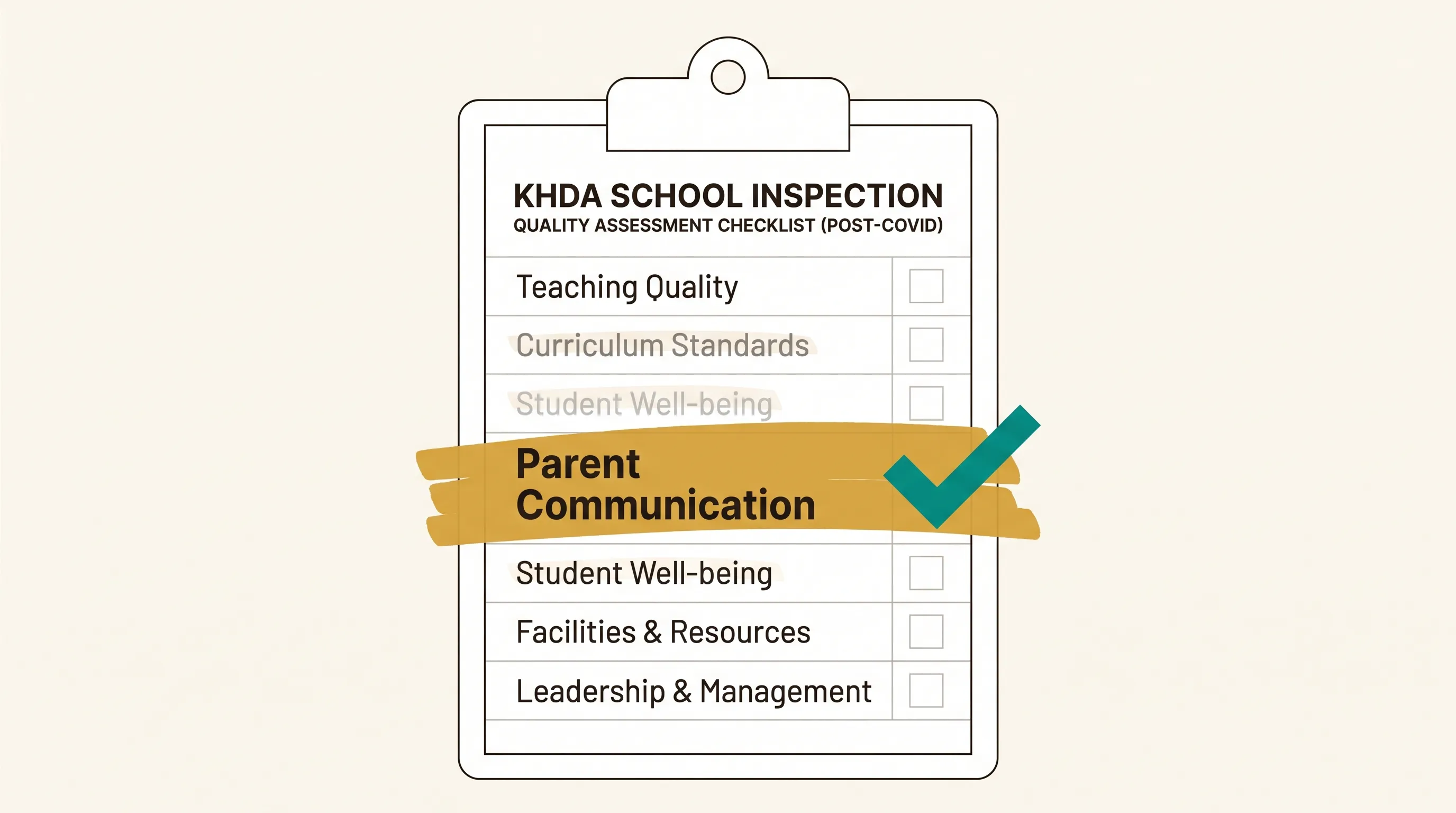
This is the part that turns policy trivia into an operational task with a deadline. KHDA paused quality assurance inspections for the 2024-25 and 2025-26 academic years (except third-year new schools), and they are resuming for 2026-27. When they do, “schools will usually be given very short notice — typically no more than 24 hours” before inspectors arrive (Khaleej Times, KHDA quality visits). A school that hasn’t kept a running, dated complaint record for two academic years has no time to reconstruct one once that notice lands.
Arcadia Global School, a private school in Al Furjan, Dubai, publishes its own three-stage model, and it’s a useful template regardless of which school runs it. Stage 1 informal concerns “must be resolved or moved to the next stage within 48 hours.” Stage 2 formal complaints get acknowledged by the relevant staff member within 24 hours, a meeting to discuss the outcome happens “within 5 working days of the acknowledgment,” and records are filed accordingly — a complaint about the school in general goes into the school’s ‘Parent Hub’ log, “retained for a period of two years,” while a complaint about a specific member of staff is filed to that staff member’s own record instead. Stage 3, if it escalates to the Executive Principal, follows the same 24-hour acknowledgement, gives the parent five working days to add detail, and produces written findings “within ten (10) working days from the meeting” (Arcadia Global School Feedback and Complaints Policy 2024-2026). The policy also tells parents plainly that they “may approach KHDA directly after the last or any stage of this complaint’s procedure” — including after a child has already left the school. That’s the KHDA-facing safety valve every Dubai school should be stating in writing, not leaving implicit.
The timelines at a glance:
- e-Feedback complaint against a school: resolved within 10 working days (KHDA)
- Customer Service Charter complaint against KHDA: acknowledged within 1 working day, proposed resolution within 7 working days
- Arcadia Stage 1 (informal concern): resolved or escalated within 48 hours
- Arcadia Stage 2 (formal complaint): acknowledged within 24 hours, outcome meeting within 5 working days
- Arcadia Stage 3 (Executive Principal): written findings within 10 working days of the meeting
- Complaint record retention: at least 2 years
What this looks like operationally, whatever software or paper trail a school uses: every complaint gets a timestamp the moment it’s raised, a named staff member attached to it, an acknowledgement logged within 24-48 hours, and a resolution note dated and retained for at least two years — the retention period Arcadia’s own policy uses. Or, for the disciplinary side specifically: any suspension or exclusion decision gets a written justification filed alongside the complaint record it relates to, so that if KHDA asks why a decision was made, the answer already exists as a document rather than a memory. A log that only lives in one administrator’s email inbox fails the moment that person is unreachable during a 24-hour-notice visit.
Complaint logs aren’t the whole compliance picture
None of this makes complaint handling the whole of KHDA compliance. The academic-calendar rules, the ADEK-style attendance and contract mandates taking hold in Abu Dhabi, and the broader inspection framework all sit alongside communication as separate, independently-checked factors — a school with an airtight complaint log but a calendar that quietly drifts from the MoE-approved term dates is still out of compliance. The point isn’t that a complaint log substitutes for the rest of the regulatory picture; it’s that it’s the one piece most schools currently treat as informal, and it’s also the piece an inspector arriving on 24 hours’ notice can ask to see immediately.
What to have ready before 2026-27
The concrete requirement coming out of all this is unglamorous: a dated, retrievable, cross-staff-visible complaint record, tied to acknowledgement and resolution timestamps that sit inside KHDA’s own working-day expectations, plus a calendar and attendance policy that’s actually the one your regulator published this year rather than last year’s version everyone forgot to update. Purpose-built communication platforms exist specifically to make that record automatic rather than dependent on one person’s inbox — a parent’s e-Feedback-triggered complaint thread, timestamped from the front-office reply to the resolution note, still visible to the new admissions lead six months later, rather than buried in a departed staff member’s inbox. BeeNet is one implementation path for the record-keeping side — its messaging and document tools keep that dated, staff-visible history without extra manual logging.
The calendar side is a separate problem with a separate fix: its notification tools help keep term-date and attendance changes reaching every parent through more than one channel, the same multi-channel habit ADEK is now mandating in Abu Dhabi. Schools already using something similar can check their setup against the sections above; schools without one can see how it fits their own process via a demo or by reviewing school-specific features first.
Inspections are coming back in 2026-27, on short notice, and the KHDA parent portal already gives parents a direct route around your front office. The question for a Dubai school in 2026 isn’t whether to formalize complaint handling — KHDA’s own charter and one school’s published policy both show what “formalized” looks like — it’s whether that record exists before the 24-hour notice arrives, not after.
References
- KHDA (Knowledge and Human Development Authority, Dubai). “Customer Service Charter, Version 3.0.” 2025. https://web.khda.gov.ae/KHDA/media/documents/Service-Charter-English.pdf
- KHDA. “Academic Calendar for Dubai’s Private Schools.” 2026. https://web.khda.gov.ae/en/resources/academic-calendar-dubai-private-schools
- KHDA. “Common Questions for Parents.” 2025 (page last updated 2021). https://web.khda.gov.ae/en/Guides/Parents/Common-Question-For-Parents/Common-Questions-for-Parents
- KHDA. “e-Feedback (Complaints, Enquiries, Suggestions).” 2026. https://web.khda.gov.ae/en/khdafeedback
- UAE Ministry of Education. “Ministry of Education announces the academic calendar for the next three years.” 2026. https://moe.gov.ae/en/mediacenter/news/Pages/MOE-announces-the-academic-calendar-for-the-next-3-years.aspx
- Sircar, Nandini. “New attendance rules in Abu Dhabi: Key policies parents must know.” Khaleej Times, 2025. https://www.khaleejtimes.com/uae/education/school-attendance-rules-abu-dhabi
- Rasheed, Abdulla. “Abu Dhabi mandates annual parent-school contracts for private schools.” Gulf News, 2025. https://gulfnews.com/uae/education/abu-dhabi-mandates-annual-parent-school-contracts-for-private-schools-1.500092264
- Arcadia Global School (Al Furjan, Dubai). “Feedback and Complaints Policy 2024-2026.” 2025. https://arcadiaglobal.sch.ae/wp-content/uploads/2025/01/AGS-Feedback-and-Complaints-Policy.pdf
- Sircar, Nandini. “New quality check visits announced for Dubai schools.” Khaleej Times, 2026. https://www.khaleejtimes.com/uae/education/khda-quality-visits-dubai-schools-explainer


Related BeeNet Features
Ready to Transform Your School Communication?
Start saving time and increasing parent engagement with BeeNet.
Request Demo