France's Parent-School Charter for Rentrée 2026
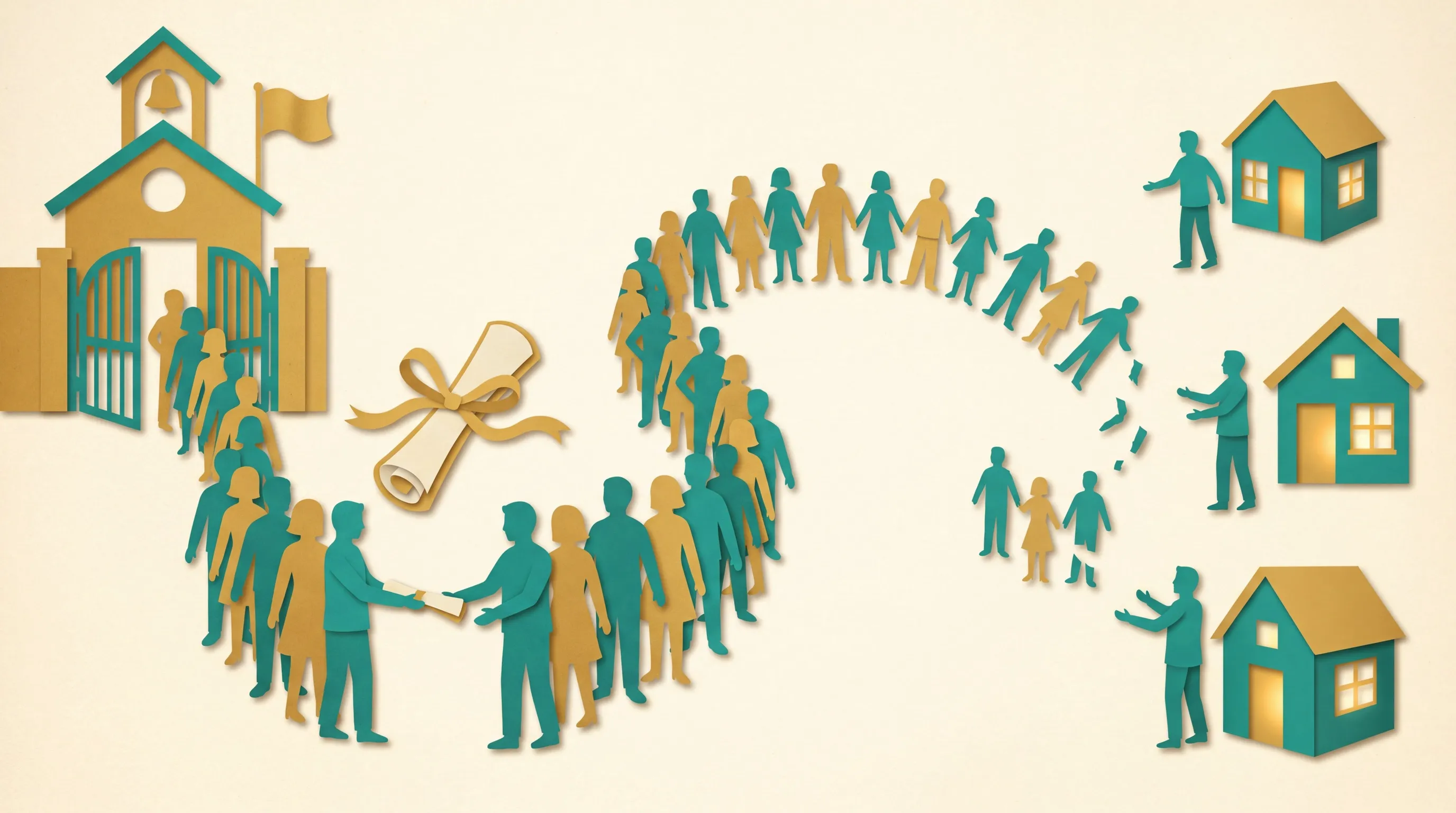
France’s parent-school charter (the Charte Parents-École) took effect on 25 August 2026. The ministry addresses it to every école, collège and lycée (public or private is never specified), leaving presentation to each school’s own initiative and saying nothing about parents who miss it. The charter itself is a one-page poster of reciprocal commitments (what the school owes families and what families owe the school) organized into three cadences: at rentrée, throughout the year, and a handful of times per year Charte Parents-École. It is not a form to sign and file; the ministry’s own guide calls it “plus qu’un document remis en début d’année… une référence commune qui accompagne les relations… tout au long de la scolarité,” meaning more than a start-of-year handout: a shared reference for the whole school year Guide d’accompagnement.
What the Charter Requires, and Who It Binds
Four facts settle what any école, collège or lycée director needs to act on this term:
| Question | Answer |
|---|---|
| Published | 25 August 2026, Ministère de l’Éducation nationale |
| Who it addresses | Every école, collège and lycée director and chef d’établissement, with presentation left to each school’s initiative |
| Named venue | The rentrée class meeting for parents (“moment privilégié”); staff briefing 31 August, parent meetings in September professeurs-des-ecoles.com; see our rentrée 2026-2027 dates and parent-contact checklist |
| Format | Left to each school’s discretion: no mandated document, script, or channel |
| Duration of obligation | Ongoing, “tout au long de la scolarité,” not a one-time presentation |
The guide is explicit that the class meeting is a recommendation, not a mandate: “les modalités de présentation sont à l’initiative de chaque école, collège et lycée” Guide d’accompagnement. An accompanying video is meant to run at that same meeting FCPE 78, and a government reconfirmation on 21 September framed the charter partly as a digital-literacy document: screen use and family digital habits, not only discipline and attendance tne.trousseaprojets.fr.
Where the Ministry’s Guidance Stops Short
Read both ministry PDFs closely and one gap stands out: neither addresses the parent who does not attend the class meeting. The guide names “the rentrée meetings organized for parents” as the privileged moment to present the charter, but it does not say what a school should do for the family that works that evening, has a younger sibling to manage, or never received the meeting invitation in a language they read. That is a real, specific gap: one named venue with no fallback.
FCPE 78, a national parent-federation chapter, welcomed the charter with a caveat worth repeating to staff before rollout: it should function “as a tool for reciprocal dialogue, not a document used solely to call families to order” FCPE 78. The ministry’s guide also asserts that schools with a “régulière et constructive” relationship with families “généralement” see fewer conflict situations Guide d’accompagnement. That’s worth repeating to staff as the ministry’s own rationale, since the guide cites no study behind it. The charter is also not the only 2026 text to hand schools a parent-communication duty without a protocol: the maternelle 2026 parent-communication mandate follows the same pattern.
The Gap the Charter Lands On
That missing fallback matters more because of what the charter is landing on. The “one meeting, no fallback” problem is not new: it sits on top of an existing, uneven digital-equity gap. A 2025 official inspection report (IGÉSR) found that 62% of public elementary schools have an ENT (up from 55% in 2023), and that ENT coverage reaches 92% of secondary students but only 64% of primary students and their parents vie-publique.fr / IGÉSR. The same report documented établissements running up to four separate messaging channels in parallel: ENT messaging, Pronote messaging, an académie mailbox, and personal messaging, with the mix itself generating confusion about which channel to use vie-publique.fr / IGÉSR.
An honest reckoning: it would be a mistake to credit the charter alone with fixing family reach, or to blame the charter’s silence on absentees for a problem it inherited. The inspection report predates the charter by more than a year and describes a structural gap: primary schools under-equipped relative to secondary, and channels that fragment rather than consolidate. The charter adds an obligation to communicate more; it does nothing, on its own, to close that infrastructure gap. Reading the charter as a mandate to reach every family, without also reading the report it sits on top of, overstates what a one-page poster changes.
The inspectors’ own recommendations point at the fix: formalize communication tools in the school’s official planning documents, and let parent representatives broadcast directly to consenting parents through the ENT, “l’ensemble des parents, par niveau ou par classe” vie-publique.fr / IGÉSR. That is a consolidation problem, and it is solvable independently of whether the charter itself ever gets more specific.
Making the Rentrée Presentation Reach Everyone
The charter names one venue. A director’s job this term is closing the gap between that venue and every family on the roster.
In practice: covering the family who missed the meeting
Channel: an in-app announcement to all parents plus an SMS to any parent without the app, sent the day after each class’s rentrée meeting. Frequency: once, with one reminder a week later to families who have not opened it. Trigger: the class meeting date on the school calendar. Sample content: “Ce soir, la classe de CE2 a présenté la Charte Parents-École 2026. Voici le document et la vidéo si vous n’avez pas pu être présent(e) : [lien]. Une question ? Répondez à ce message.” Attaching the ministry PDF and video link means a parent who missed the room does not miss the content.
In practice: keeping it a reference, not a handout
Channel: a short recurring announcement at the start of each trimester, tied to the charter’s “tout au long de l’année” commitments (grades, progress, behavior updates). Frequency: three times a year, aligned to report-card periods. Trigger: the start of each trimester. Sample content: a two-line reminder of what the school committed to that period (“Ce trimestre : bulletins le 12/12, rendez-vous parents-professeurs la semaine du 15/12”) linking back to the original charter document, so the poster stays a living reference instead of a memory from September.
Presenting the charter is also a natural moment to collect a signed or e-signed acknowledgment, and to record parent contact preferences and language needs at the same time, solving the “who missed it” problem for the next communication, not just this one.
Timing This Before the Next Meeting, Not After
The charter is silent on absent families because format was deliberately left to schools, which means the fallback plan is a decision a director makes, not a gap the ministry will fill later this year. The class meetings already happened in September; for schools on a trimester calendar, the next natural checkpoint is the first report-card and parent-teacher meeting window in December, when the charter’s “tout au long de l’année” commitments become concrete for the first time. Lycées on a semester calendar will hit that same checkpoint on their own schedule instead. Building the reach-every-family habit now, before that checkpoint, is cheaper than reconstructing who received what after a complaint arrives.
A charter that lives only in the room where it was first shown will not survive to the “tout au long de la scolarité” the ministry describes. Closing the reach gap takes a channel that works for every family a school has enrolled, including the ones who never made it into the room, which is an operational requirement, not a document problem. Purpose-built parent-communication platforms exist specifically to combine in-app announcements with SMS delivery for parents without the app, plus digital consent and e-signature collection for the acknowledgment itself. BeeNet is one implementation of that combination. If reaching every family, not just meeting attendees, is this term’s open question, a 20-minute demo is a low-cost way to see the combination in practice.
References
- Ministère de l’Éducation nationale (Éduscol), “Charte Parents-École,” 25 August 2026. https://eduscol.education.gouv.fr/sites/default/files/document/charte-parents-ecole-128764.pdf
- Ministère de l’Éducation nationale (Éduscol), “Guide d’accompagnement des directeurs d’école et des chefs d’établissement,” 25 August 2026. https://eduscol.education.gouv.fr/sites/default/files/document/guidecharteparentecolepdf-128776.pdf
- professeurs-des-ecoles.com, “Le ministère dévoile une charte Parents – École,” 27 August 2026. https://www.professeurs-des-ecoles.com/2026/08/27/le-ministere-devoile-une-charte-parents-ecole/
- FCPE 78 (Conseil Départemental FCPE des Yvelines), “Rentrée scolaire 2026 : ce qu’il faut retenir des annonces ministérielles,” 27 August 2026. https://www.fcpe78.fr/2026/08/27/rentree-scolaire-2026-ce-quil-faut-retenir-des-annonces-ministerielles/
- Ministère de l’Éducation nationale — Parentalité et Numérique, “Une nouvelle charte Parents-École pour la rentrée 2026,” 21 September 2026. https://tne.trousseaprojets.fr/actualites/nouvelle-charte-parents-ecole-2026
- IGÉSR (Isabelle Bourhis, Hervé Ferrage, Laurent Le Prieur, Luc Pham), “Usages du numérique dans la relation École-familles,” Rapport N° 24-25 140C, June 2025. https://www.vie-publique.fr/files/rapport/pdf/299814.pdf



Ready to Transform Your School Communication?
Start saving time and increasing parent engagement with BeeNet.
Request Demo