Belgium's School Climate Decree: What the New 'Bullying Delegate' Means for Parent Communication
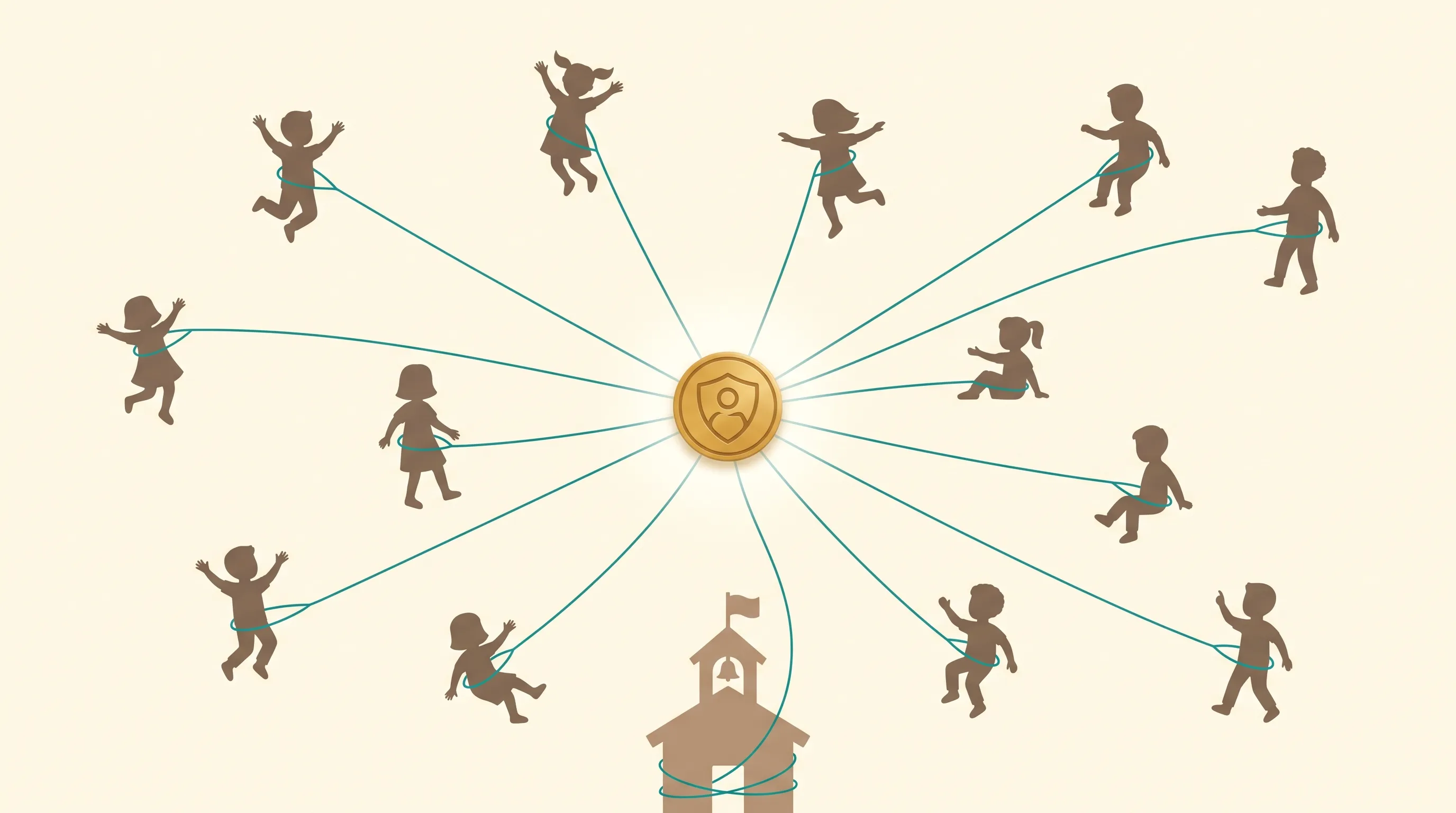
As of July 2026, 235 schools in Belgium’s Fédération Wallonie-Bruxelles (FWB) are legally required to name a staff member responsible for how bullying gets reported, tracked, and communicated to parents — the FWB government approved more than €1.4 million in funding for 2026-2027 to support a four-year accompaniment framework built around this role, formally called the “délégué(e) en charge du climat scolaire et du bien-être à l’école” (school climate and wellbeing delegate) BX1. For school leaders anywhere family-safety communication has so far been a matter of judgment call rather than protocol, the shift is worth understanding — not because Belgium’s exact legal mechanism will travel everywhere, but because the underlying problem it addresses does.
What the decree actually requires
The role isn’t new window dressing. It traces back to the founding “Décret du 27 avril 2023 relatif à l’amélioration du climat scolaire,” which established the delegate position, a formal “procédure de signalement” (reporting procedure) for bullying and cyberbullying incidents, a school-support mechanism, and an “Observatoire du climat scolaire” to track outcomes across participating schools FWB/Gallilex. A 2026 amending decree, deposited in May and adopted in June, extends and funds the framework for a fourth year.
If you want to see where your own school stands, our free school climate check gives you a benchmark in a few minutes.
Two details matter most for administrators outside Belgium sizing up whether this is a passing regulatory footnote or a bellwether. First, the delegate role is formally written into each school’s management plan and is subject to “regular evaluation” — this is not a badge, it’s an audited responsibility RTBF. Second, the program has scaled since its launch: roughly 200 schools were projected to join for the 2023-2024 school year, 118 schools actually made up that first cohort, and the program has since grown to 235 schools continuing for 2026-2027 Pacte pour un Enseignement d’excellence. Belgium isn’t alone in formalizing this kind of role — Spain’s 2020 Education Law amendment introduced a comparable obligation for every school to appoint a “well-being and protection co-ordinator” and implement anti-bullying protocols OECD Working Paper No. 341, and France’s 2022 law made school bullying a specific criminal offence — a different lever, same underlying pressure to formalize what used to be discretionary.
The numbers behind the urgency
The decree didn’t appear in a vacuum. Convergent Belgian data — drawn from PISA 2022, PIRLS 2021, and HBSC 2022 — show that roughly 20% of FWB students report experiencing a harassment situation at least monthly, and FWB’s own broader figure puts 1 in 3 children as involved in a harassment situation in some capacity, whether as author, witness, or target Délégué général aux droits de l’enfant. That FWB rate sits meaningfully above the broader European picture: WHO/Europe’s HBSC study of 44 countries found cyberbullying victimization climbed from 12-13% in 2018 to roughly 15-16% (“one in six”) in 2021/2022, while in-person school bullying has held closer to 11% over the same period WHO/Europe. Whatever a given country’s exact legal answer, the trend line — cyberbullying rising while classic schoolyard bullying stays roughly flat — is a European-wide pattern, not a Belgian anomaly.
What the role looks like in practice
The clearest concrete illustration in FWB’s own materials comes from Princesse Elisabeth municipal school in Charleroi. An externalized school-climate diagnosis there found a high rate of mockery and teasing among students. In response, the school revised its internal regulations, installed an anonymous reporting channel for students, and appointed a “climat scolaire” referent to chair a quarterly steering committee that reviews incidents and prevention progress Pacte pour un Enseignement d’excellence. FWB has since made available to participating schools an official template describing the délégué’s mission and duties, formalizing across all 235 schools the same basic elements Charleroi’s example shows in practice: a reporting channel, an accountable owner, and a fixed review cadence. Belgium’s children’s-rights ombudsman goes further, recommending that every province replicate two specific existing models — the Cellule de Référence et d’Intervention Harcèlement (CRIH) in La Louvière and the Réseau Prévention Harcèlement (RPH) in Namur — the point being a shared, province-wide referral network rather than each school building its own response from scratch Délégué général aux droits de l’enfant.
To make this concrete for a school evaluating what “structured notification” could look like day to day: a delegate-led protocol might specify that any reported bullying incident triggers a same-day acknowledgment to the family who reported it (a short message confirming the report was received and naming a follow-up window, sent same-day through whatever channel the school already uses for routine notices — email, app, or SMS), followed by a brief written update to the families of both students involved within 3-5 school days once the delegate has reviewed the incident, and a termly summary — one page, no names — shared with the parent council showing incident volume and category trends. None of that is drawn from a named FWB template; it’s an illustration of what “the delegate coordinates signalling procedures” tends to translate into operationally.
Does the role itself reduce bullying?
Here the evidence gets more cautious, and it’s worth stating plainly rather than glossing over. The OECD’s 2026 working paper on bullying across OECD countries is explicit that governance measures like appointing a mandated role or team are “rarely the subject of robust impact evaluations,” and that the evidence base for their effectiveness is limited OECD Working Paper No. 341. Where the paper does isolate causal evidence — from quasi-experimental, difference-in-differences studies of US anti-bullying laws, a stronger intervention than a single school-level role — it found those laws associated with roughly a 10% reduction in self-reported bullying risk, and school leaders in states with such legislation reported up to 8.4% fewer incidents than those without, with the strongest effects for female and LGBTQI+ students. Belgium’s own comparative benchmark, Finland’s KiVa program, is credited in the ombudsman’s opinion with a finding that bullying risk runs 1.2 to 1.3 times higher in non-KiVa classrooms — a program-level correlation, not an isolated-role effect, since KiVa bundles prevention, intervention, and monitoring together. The same opinion singles out teacher-team cohesion, not the delegate role alone, as “one of the best protections against victimization.”
A short honest reckoning. A named delegate and a documented reporting procedure are necessary infrastructure, but the research consistently attributes durable reductions in bullying to whole-school program design — sustained staff training, a defined referral network, and monitoring — rather than to the existence of a role in isolation, so formalizing the position is a starting point, not the finish line. The OECD also flags substantial disparities that a communication protocol alone won’t close: among socioeconomically advantaged students, boys with an immigrant background score 64% higher on a bullying-intensity index than native-born girls in the same advantaged group — a reminder that who is at elevated risk varies by background, not only by whether a school has appointed someone to watch for it.
What this means for your school’s parent communication
Whether or not a school operates under FWB’s specific decree, the direction it signals is one more administrators across Europe and MENA markets — including schools evaluating their own communication stack — are likely to meet in some form: family notification around bullying and cyberbullying incidents is moving from a discretionary judgment call toward something schools are expected to document, timestamp, and be able to show evidence of. A few concrete steps follow from the FWB experience and the OECD’s comparative work:
- Name one accountable person, even informally, before regulation forces the question — Princesse Elisabeth’s quarterly steering committee shows the model scales down to a single school easily.
- Write down your notification timeline — same-day acknowledgment, a follow-up window measured in days rather than “soon,” and a periodic aggregate report to your parent body — so families know what to expect and staff know what’s owed.
- Keep a paper trail that’s easy to produce — a timestamped log of who was notified, through which channel, and when, exportable as a single report rather than reconstructed from someone’s inbox, because the OECD’s own caution about weak impact evidence cuts both ways: if you can’t show what you did and when, you can’t tell whether it worked either.
- Don’t stop at the role. Pair a named delegate with recurring staff training and a defined escalation path — the ombudsman’s and OECD’s shared finding is that the structure around the role matters as much as the role itself.
None of this requires waiting for a decree. The practical conclusion FWB’s rollout points to is straightforward: a documented, timestamped, dual-family notification workflow for safety incidents is cheap to build now and expensive to reconstruct under scrutiny later. A platform that already centralizes parent-teacher messaging and notification records — like BeeNet’s messaging and notification tools — is one implementation path for schools that want that trail built in rather than assembled by hand after the fact. It isn’t the only way to get there, but if your current process for who was told what, and when, lives in someone’s email inbox, this is a reasonable moment to change that. If you’d like to see how a structured incident-notification workflow could fit your school, book a demo.
References
- BX1. “Harcèlement scolaire : plus de 1,4 million d’euros pour accompagner les écoles en Fédération Wallonie-Bruxelles.” 2026. https://bx1.be/categories/societe/harcelement-scolaire-plus-de-14-million-deuros-pour-accompagner-les-ecoles-en-federation-wallonie-bruxelles/
- RTBF. “Harcèlement scolaire : plus de 1,4 million d’euros investis en Fédération Wallonie-Bruxelles pour 2026-2027.” 2026. https://www.rtbf.be/article/harcelement-scolaire-plus-de-1-4-million-d-euros-investis-en-federation-wallonie-bruxelles-pour-2026-2027-11761645
- Parlement de la Fédération Wallonie-Bruxelles / Gallilex. “Projet de décret modifiant le décret du 27 avril 2023 relatif à l’amélioration du climat scolaire et à la prévention du harcèlement et du cyberharcèlement scolaires.” 2026 (amending); 2023 (founding decree). https://www.pfwb.be/documents-parlementaires/document-pjd-001852193
- Délégué général aux droits de l’enfant (Fédération Wallonie-Bruxelles). “Avis du Délégué général aux droits de l’enfant relatif au (cyber)harcèlement scolaire en Fédération Wallonie-Bruxelles.” November 3, 2025. https://www.defenseurdesenfants.be/sites/default/files/inline-files/20251103-avis-du-delegue-general-aux-droits-de-l-enfant-relatif-au-cyber-harcelement-scolaire-en-federation-wallonie-bruxelles_1.pdf
- Pereira, Julie. “Bullying in education: Prevalence, impact and responses across countries.” OECD Education Working Papers No. 341. February 2026. https://www.oecd.org/content/dam/oecd/en/publications/reports/2026/02/bullying-in-education_8e2a22d9/d9f8bd9f-en.pdf
- WHO Regional Office for Europe. “One in six school-aged children experiences cyberbullying, finds new WHO/Europe study.” March 27, 2024. https://www.who.int/europe/news/item/27-03-2024-one-in-six-school-aged-children-experiences-cyberbullying—finds-new-who-europe-study
- Fédération Wallonie-Bruxelles / Pacte pour un Enseignement d’excellence. “Le climat et le bien-être à l’école.” 2025. https://pactepourunenseignementdexcellence.cfwb.be/mesures/le-climat-et-le-bien-etre-a-lecole/
Ready to Transform Your School Communication?
Start saving time and increasing parent engagement with BeeNet.
Request Demo